Sunday, February 20, 2011

Back in Alexandria

We are now back in Alexandria, and life seems pretty much back to normal - apart from a number of burnt out police stations and a lot of tanks still deployed on the streets. Here's one outside a bank behind the Alexandria Library:

As you can see, they have become a bit of a tourist attraction, with families taking pictures of their kids sat on a tank, or with the soldiers.

There are other, more subtle changes though. The first is in freedom of expression - people are openly debating politics in a way that just didn't happen before. A few days ago I listened to a couple of friends discuss the state of the country. One had participated in the demonstrations throughout and could not be prouder of what had happened. The other was still vehemently pro-Mubarak and saw what had happened to him as sacrilege. This conversation wouldn't (couldn't) have taken place just a month ago. It was impressive to witness. (And nice that all the political/media Arabic vocab we've been studying has come to good use!)

The second change is a little more subtle. People seem much prouder of their country and of themselves. It is not just about freedom of expression, but a belief that their actions can have a positive impact on society.

During the unrest, the police deserted the streets. Neighbourhoods set up "People's Committees" to guard the streets at night. At the start of the unrest, these were described in the media as 'vigilante' groups, but that is a rather negative way of describing what has actually been remarkable community action. Night after night, people worked together with their neighbours, who they might not have ever met before, to collectively ensure the streets stayed safe. (Alexandria is a densely populated city, so even the leafy suburbs consist of high-rise apartment blocks - so it's not easy to meet people in the same way as it is on a street of houses.) Others also gathered up rubbish, because regular collections had stopped. Everyone we've spoken to who participated in these Committees has said what a great thing they were - people met for the first time, discovered the power of working together, and were able to play a real role in society, perhaps for the first time. We've seen the difference in various young guys we know - they seem a little more confident, stand a little taller, believe that they can make a positive difference.

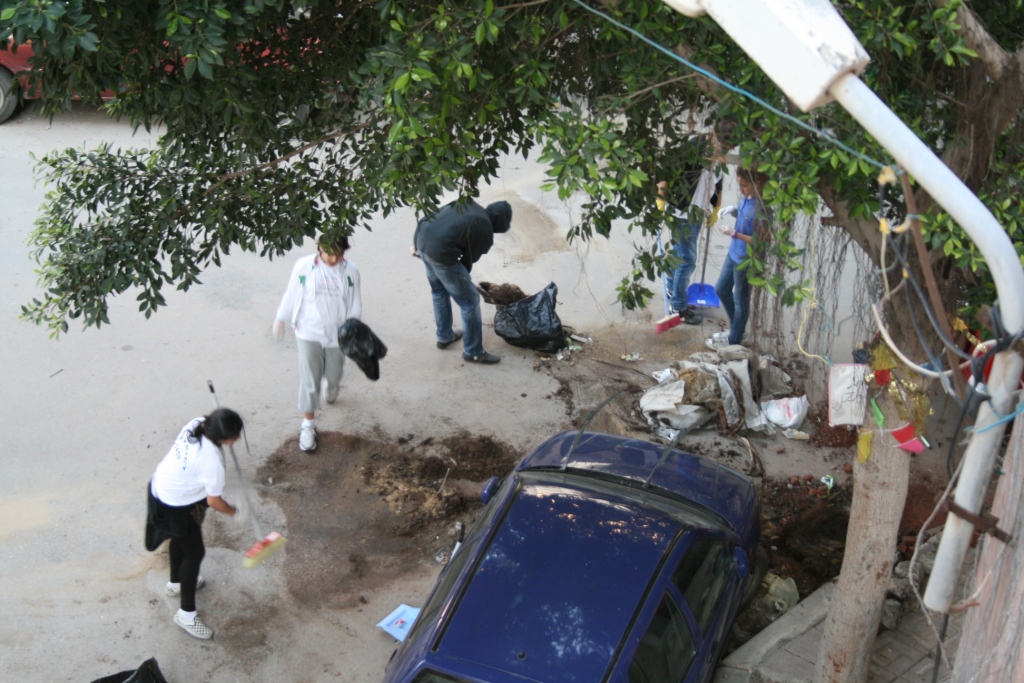
Right now, outside our flat, a group of teenagers is cleaning the street:


 People all over Egypt are helping to clear up after the protests. This woman posting on the CNN site puts it very well:
"Every Egyptian wanted to help clean up the square  after the Revolution.
Me and my friends volunteered in cleaning the streets.
I wanted to see a new Egypt without the dirt of the past.
This revolution didn't only change the people in power, it awakened something in every single Egyptian that made him eager to build a new country for a brighter future ."
For the kids in our neighbourhood, it's not just cleaning up from what happened over the last few weeks - it's 'ordinary' rubbish on the streets, sorting recycling, repainting tram stations, and generally making the streets cleaner than they were before.

Otherwise, life goes on as normal - but it's a cleaner, more optimistic normal. Which is nice!

Friday, February 4, 2011

10 days and counting

It’s a quarter past mid-day and Friday Prayers are in progress. The TV is on, and we can see the crowds massed in Tahrir Square. Outside our flat the fields are quiet apart from sound of the prayers from the mosque at the end of the lane – and the rumble of a passing tractor, since harvests and animals don’t wait for politics.

Tahrir Square is now the quietest it has been for 10 days, as the prayers go on. I would imagine that all across Egypt, people are similarly quiet, waiting to see what happens next.  (The moments after Friday prayers are typically when unrest begins – as people who have gathered together begin to leave mosques.)

We can hear 3 mosques now from our balcony (the one at the end of the lane was a little ahead of the others.) The noise is great: “God is great.”

* * * * *

I have been thinking long and hard since I posted my last update. Sitting down now to write, I want to pass on some of the different feelings people have expressed to me over the last week. I think the people I know or have met in passing represent a fairly broad range of social class and outlook: well-off or not; university degrees or barely literate; Muslim and Christian; from town or country or between the two as many are, living in the city but with strong ties to their family’s villages.

It would be nice to say that a single voice unites these people, but this is not the case.

Many of my friends have made their antipathy to the government clear on Facebook in recent days. But a good deal of others have expressed their support for Mubarak. It isn’t possible to determine what ‘type’ of person might express one view or the other. It isn’t about what your religious views are, or your social background. One religious conservative I know is staunchly with the government. Another is desperate for reform. There are the same differences with friends who have been educated at international schools (in English with a US or UK curriculum).

But then why should we expect anything else? In the UK and in America, we might make some broad assumptions about what sort of person is Tory or Labour, Republican or Democrat, but in fact support could come from anywhere. Remember this point – I’ll come back to it later.

My overall impression is that nearly everyone wants change, that most people think that Mubarak’s government is the first thing that needs to change, but that when it comes to the timescales, particularly with the fear of chaos, voices are much less unified.

* * * * *

Over the last few days the biggest group of people, from both sides of the debate, have been calling simply for calm to resume.

This is the great difficulty. Tourists have fled from Luxor in their thousands. Most of the foreigners who remain are long-term residents. Tourism is the life-blood of Luxor. A Canadian neighbour who went across the river yesterday reported that the five-star hotels are essentially empty, and the staff have been sent home (and won’t get paid as a result.)

Reports from other towns are grim. TV cameras are tuned on Cairo and Alexandria, (and tourist-sustained Luxor is a different kettle of fish.) But a young man with relatives in Minya, for example, reports that the situation there is bad. Similarly an old internet friend reports that in Port Said order has broken down: they are relying on the Imam from the nearest mosque to warn them over the loudspeakers when looters are approaching their building, so they can defend themselves with sticks and stones.

* * * * *

Yesterday in an interview with ABC News, President Mubarak said that he feared such chaos if he stood down now. The irony here is that in trying to fortify his position in this way, he has exposed the greatest weakness of his system. Egypt is a country of 80 million people. It borders Sudan, Israel, Libya and Jordan. It joins Europe to the oil supplies of the Gulf via the Suez Canal. If the stability of all this is contingent upon the rule of ONE man, as Mubarak claims, then the world has a lot to worry about. He’s in his eighties, don’t forget.

On the other hand, if an American president fell, or a British Prime Minister, or a German chancellor, then the world might sense the ripples, but the apparatus of that country would continue. The police would continue to protect citizens and maintain the law; the financial system would go on functioning, and people would get paid. Belgium has functioned without a government for months!

We complain a lot in the UK. (We are free to complain as much as we like, thank heavens.) But ultimately we have a whole series of checks and balances which maintain a stable system. Power is not concentrated in the hands of one man and one regime. The government has power, but the civil service is a machine of its own; the police, the army, the media, large private companies, religious organisations, charities, celebrities, social groups – all have power in different forms, and the ability to influence the way the country operates.

So either Mubarak is right, and he is all that stands between order and chaos, in which case something needs to change for the safety of the region. Or he’s wrong, in which case change can take place readily, for the safety of the region.

* * * * *

So how has Mubarak sustained his position?

Earlier on I mentioned the broad spectrum of views, and the disparate nature of the people who might express them. If you listen to Mubarak, the only alternative to his rule is the Muslim Brotherhood, whom he has portrayed as a fundamentalist, anti-Western movement. With this fear, he has reined in support both at home and abroad.

Leaving aside the matter of what the Muslim Brotherhood really stands for, he is offering a false dichotomy.  It is not a choice between “him and them”.

Egyptians have a diverse range of views. The majority of Egyptians are Muslim (around 90%) but some are socially/economically/politically conservative and some are liberal. Most are probably somewhere in between: family- and community-minded, aware of Egypt’s long past, anxious to preserve their values, but desirous of change so that views can be expressed, jobs created, the poor fed, public health improved and opportunities created.

The world does not need to be afraid of allowing the Egyptian people to choose their government.

* * * * *

The Vice-President has repeatedly labelled the protestors a ‘youth movement.’ I have to say, from the point of view of the current regime, anyone under the age of 60 probably counts as ‘youth’.

So I’d like to end with the point of view of one of Egypt’s youth: Patrick had the following conversation with the 11-year old son of a friend:

“I love America, life is great there.”
“Do you want to live in America one day?”
“No way!”
“Why not? You think it's great!”
“Yeah, but one day I want to make life here in Egypt as good as life in America.”


Sunday, January 30, 2011

Some thoughts from Egypt in the middle of a revolution

Sunday, 30 January 2011
Luxor, Egypt


When we came to Egypt in September, the last thing I thought we would witness was a revolution. As we sit here, in the relative safety of Luxor’s West Bank (the rural side of the river) watching events unfold on television, I barely know what to think, let alone what to write.

It is just after 5pm local time. Officially, the whole country is under curfew. From the balcony of our holiday flat the fields are bathed in low, rich, evening sunlight. Two women are driving a small flock of sheep along a path between banana trees. In the walled garden of the next house, a man in traditional dress is weeding the grass. His two kids are circling the terrace on the bicycles – just now they both tried to ride on the same bike for a while, but after half a circle they both fell off giggling.

Inside, on television, we are watching scenes of Tahrir Square (the name means ‘Liberation’ and it is a symbolic location for Egyptians) where thousands of demonstrators are gathering. Fighter planes have swooped down over the square, and helicopters have been hovering overhead.

So where do I start? My thoughts and feelings are so bound up with everything I have witnessed over the last five months, and the things I have learnt about Egypt and Egyptians. Last week one of our teachers suggested that we write a kind of ‘mid-term report’ on our impressions about Egypt. I was going to gather my thoughts over the next few weeks and write something at the start of February which would be six months after our arrival.  But the latest events have accelerated my thinking.

What follows is not an organised, argued essay. It’s just a bunch of thoughts, hopefully not too much of a rant.

* * * * *

Back in December, Egypt held parliamentary elections. I wrote an article about the elections for a friend’s political website. I did my research, spoke to people, verified what I was told; but in the end, Patrick and I decided that it was not a good idea express negative views about the Mubarak regime. (A telling sign of the way things are.) My article remains saved on my laptop, and reading it back now makes my heart heavy.

The fate of the Egyptian people has for many years been bound up closely in Western regional goals. Egypt has been a good ally to the US. When Mubarak wiped the floor with his opponents in the elections, the reaction from the US was lukewarm. Here’s what I wrote at the time:
The reaction from the international community has been half-hearted. The US State Department issued a statement expressing their “disappointment” and “dismay,” although of course their ultimate tone was conciliatory, emphasising their “longstanding partnership with the government and the people of Egypt” which they look forward to continuing.
This is the fundamental point. Iran’s controversial elections last year raised international outcry. The Ivorian Coast’s presidential elections are currently headline news on the BBC, with world leaders lining up to dispute the incumbent president’s overturning of the legitimate result. But Egypt is more useful to the West. As the US ambassador put it, the Egyptians are “perhaps the only player that can talk with us, the Israelis, and all Palestinian factions.” And the Egyptian government has maintained the blockade of Gaza (with US help), despite widespread criticism at home and abroad.
But Egypt’s foreign policy is closely bound up in its own domestic politics. As the US ambassador put it, “Mubarak hates Hamas, and considers them the same as Egypt's own Muslim Brotherhood, which he sees as his own most dangerous political threat.”
I feel a little less certain about this last comment now. Does Mubarak really see the Muslim Brotherhood as his greatest threat? He has certainly made the rest of the world believe that it is the only alternative to his dictatorial rule. International commentators are warning that they do not want a new government “that doesn’t want democracy” – clearly a reference to the Muslim Brotherhood. William Hague, the British Foreign Secretary, has been more explicit, mentioning the Muslim Brotherhood by name. So the world doesn’t want a party with an Islamist agenda in charge of Egypt. It doesn’t matter if the people of Egypt would like to democratically elect such a group. Equally, it doesn’t matter if they don’t want the MB in charge. Mubarak’s rhetoric has successfully duped the world into such a fear of Islamist government that no-one is being given a chance to express an opinion either way – or to demonstrate that there are other options.

* * * * *

Let me break my rant. The sun is setting, and the TV shows thousands of protesters in Tahrir Square praying in unison. They kneel, touch their heads to the ground, pause, and rise again in waves. It is unbearably moving. The majority of Egyptians are Muslim, and united in belief. But it is more than religion that binds the people together. Reports from Alexandria on Friday said that Christian demonstrators stood around the Muslims forming a barrier against the police to protect them as they prayed. (Similarly, after the Jan 1 bombings, many Muslims stood outside churches during the Coptic Christmas services on Jan 7 to form a human shield in case of further attacks.)

According to Al Jazeera's Alexandria correspondent, women and children have taken to the streets for the first time, defying the curfew to march together against the government.

* * * * *

Back to the rant. Over the last 30 years, as the fear of Islamists has grown in the West, Egypt as a whole has made money. Most Egyptians, however, have not. Illiteracy is ridiculously high. Teachers get paid peanuts. Here’s another extract from my article:
“I am a school teacher,” said our waiter, looking over his shoulder. “In the morning I work in a primary school. I would like to see my family more – I have a wife and three children – but I have to work as a waiter in the afternoon. My salary from the school is less than $50 a month. When I want to buy one shirt for work, it costs me $18. For my children, I have to buy used clothes and shoes.”

For those who can afford it, there are excellent educational opportunities in Egypt: good schools, good universities – and hence the chance to work abroad, which so many aspire to. But with school teachers paid so badly, and education for the majority of such a low quality, social divisions will continue indefinitely.
Remember that figure, $50 a month for a teacher.  Just for the record, here are some numbers we heard from our taxi driver the other night. (Not the first time we have heard these complaints.) A few years ago, sugar cost 1.5LE (about $0.25) a kilo. That price has now quadrupled to 6LE ($1.00). With these prices you can see why $50 a month doesn’t go far. Oh, and the price of meat has risen to around $10 a kilo.

Meanwhile, a minority of Egyptians have got grossly rich under Mubarak’s regime. It is very telling that a large group of prominent businessmen are reported to have left Egypt yesterday on chartered private jets. Call me cynical, but looking at the way Egypt has developed over the last 20 years, Mubarak’s dictatorial measures have been more about lining his pockets and those of his cronies than seeing off any Islamist threat.

And the resulting ‘stability’ in Egypt protects Europe’s oil supply (from the Gulf via the Suez Canal) and maintains the border with Gaza. Back to my comments in December:
But the problem with ignoring the voices of so many is that the status quo may not prevail for long. And as tensions rise in the country, Egyptian commentators warn of sectarian tensions and the US’s Council for Foreign Relations warn that Egypt might not remain stable for long – leaving the US without the ally it needs.
But that’s not what’s important. I have talked a lot about politics, which I make no claims to know about. But over five months we have met a lot of wonderful people in Alexandria, and they are filling my thoughts right now. I hope they are all safe: those we have met through our Arabic classes: Magda, Eman, Jihan, Injy, Dina, Mohamed, Ahmed, Shereen, Hamdy, Amira; my classmates from the Greek centre: Sarah, Hadeer, Ebtesam, Yosra, Shokry, Emad, Moataz, Daniela, Souad, and so many more; Mohamed the manager of our local restaurant, and Dina who we meet there occasionally; Islam who runs a local cafĂ© we frequent, who we have bonded with over conversations about cats; our friendly doorman and his family; the man we buy vegetables from; the boy who works at the bakery where we buy breakfast; the old man at the corner shop near the language centre who greets Patrick like a long lost grandson every time he goes in; the list goes on.

We need a stable Egyptian government that serves its people well – and more to the point, this is what the Egyptian people deserve.
I wrote this in December, and watching what is unfolding before us, I hope this is what happens. I want my friends to get a good education. I want them to find work after they graduate (not sit at home for months on end, growing ever more despairing). I want them to have the chances to travel that I have had, the chances to learn, think and speak out. I want them to have hope again.

* * * * *

As night falls, we are staying indoors, maintaining our television vigil. We have stocked up on food. We are waiting to see what happens. The British Consulate in Alexandria has advised its citizens to leave the city, but so far there has been no warning for Luxor. As I said, we are in a quiet area. Most people in this village work in tourism, and they know what a huge impact these problems will have on their livelihoods.

Let me end on a lighter note. Here’s a fun game we have invented: Revolution Bingo. How many times do the TV correspondents say any of the following:

•    unprecedented scenes
•    iconic images
•    this is a turning point
•    the next few days/hours/minutes will be crucial

Mere words? I hope not.

Thursday, January 6, 2011

Have you seen this cat?

We have had a visiting cat since we moved in. She principally belongs to an American man downstairs, but she is a cat of many friends - and excellent people skills. Over the Christmas holidays when we have been around more during the day she has dropped in frequently for a saucer of tuna and a cuddle – oh and the opportunity to sniff around for the perfect spot to have her kittens.

This is Puss on Christmas Day showing off her enormous belly:


The day before yesterday, however, there was no miaowing at the door; nor yesterday; nor today.

We prevaricated a while before going to knock on her owner's door, arguing over who would speak to him (bearing in mind that we don't even know the guy's name, yet his cat occasionally sleeps on our bed at night.) In the end it was a joint effort as only the cleaner was home, and so it took our combined Arabic skills to find out that she hadn't seen Puss for a week - but maybe she had given birth in the doorman's flat. 

We went to speak to the doorman. Now our doorman is a lovely man, but I really struggle to understand anything he says, except "Ahlan, ya helwa" every time he sees me. But what we gathered is that he hasn't seen her either, but that she has probably had her kittens somewhere.

So now we are waiting on tenterhooks for Puss to come back, hopefully with a little line of kittens trailing behind her. We'll welcome them with open arms...and open tins of tuna!

Saturday, January 1, 2011

A sad start to the year

Early this morning, shortly after the new year began, a car bomb went off outside a church in Alexandria, targeting Christian worshippers leaving a service to celebrate the new year. The death toll so far stands at 21, with another 83 wounded – including both Christians and Muslims.

Any loss of human life in such a way is a tragedy, but what makes this event even sadder in my eyes is that it is at such odds with the tolerant and welcoming attitudes we have experienced from everyone we have met in Egypt.

In Cairo last week, we took a taxi from our hotel to the Khan el-Khalili - a journey of less than 3km which took almost an hour due to horrific traffic jams. Our taxi driver was rather taken with the oddity of two Arabic-speaking foreigners in his taxi, so we chatted quite happily through the whole journey. The subject turned, as it often does, to religion.

"We welcome any religion," he said. "There are two Christian families in my building. They are like my brothers. In fact closer than my brothers. They are my good friends." We went on to discuss differences in marriage, relationships, alcohol, friendships - differences between Egypt and England, Muslim and Christian, and other combinations of these 4 variables.

We have had so many similar conversations with people - open-minded, tolerant, and wanting to learn more about what is different, and what is the same.

The newspapers this morning report that official sources believe foreign groups were behind the attack. But whoever perpetrated this horrible crime, I can’t help but feel that any such sectarian violence is not just an attack on one group, but on all of Egypt; on the beautiful city of Alexandria; on the tolerant and intelligent Egyptian people, whom we have come to love and respect so much over the last few months. It is a sad start to the new year.

Saturday, December 18, 2010

Horse or Bird - you decide

Patrick & I want to buy a new phone, but we disagree about which one to buy. We have narrowed it down to two choices.

The horse:

Or the bird:


In the name of domestic harmony, we have decided to throw the choice open to the forces of democracy. You choose: horse or bird. Vote on the poll opposite.*

Voting closes on Christmas Eve at midnight in some time zone or other.

*Terms and conditions may or may not apply. I don't know. I'm not a lawyer. Whatever, really. But I promise we will abide by the results, give or take availability in store, or domestic crisis, or my right to get really stroppy and stamp my feet if I don't get my own way.

Wednesday, December 15, 2010

The infamous Egyptian taxi driver.

I recently read a blog post written by a friend of Patrick’s sister, who lives and works in Libya. In it, she describes the traffic in Tripoli in all it’s terror-inspiring madness. You can read her blog post here.  The picture is all too familiar to us here in Alexandria, especially the bit about every journey feeling like a fairground ride, with the added dimension of possible death.

It is fair to say that most taxi drivers here (with a few honourable exceptions) are entirely mad – not so much as a screw loose, more like one single screw holding their sanity together.

However it is necessary to award them a certain degree of admiration for their death-defying antics. A particular favourite of mine is what we have termed the “Magician Manoeuvre.” In one hand he holds his mobile phone so he can update his wife that yes, he is still driving down Abu Qir Street, as he has been all day; in the other hand he waves a lit cigarette; with the other hand he adjusts the radio, and with the fourth hand he changes gear. In between calls to his wife he sings along to the radio, gesticulates at people trying to  cross the road, chats to his passengers or shouts greetings to fellow taxi drivers through the open window. Throughout the whole process he weaves constantly back and forth across 3 lanes of traffic, dodging cars, motorbikes, bicycles, pedestrians, traffic cops, horses, donkeys, fruit and veg handcarts, kids playing football, etc.

A skilled driver does not let such a minor thing as lanes interfere with his quest. He thinks nothing of nipping into the fast lane for 2 seconds to overtake a solitary car, before cutting back across 5 lanes of traffic to make a right turn.

Here’s a fun game: Taxi Tat Bingo. Last week we rode in a taxi with 4 sets of furry dice, 2 dangly Quranic verses, 3 pictures of his kids, a fake-fur dashboard cover with matching parcel shelf, a golden tissue box and 7 auxiliary mirrors. There was no air freshener or 4x4 sticker, or it would have been a full house.

The Overcharger. You know you’re going to be overcharged by a couple of subtle signs: the driver changes the music to Celine Dion or Whitney Houston, and tries to befriend you in a particular type of English used only in taxis, by touts at the pyramids, and by young men in Luxor.

Our strangest (and scariest) taxi ride happened a few weeks ago. A few minutes into the journey, the driver pulled over, said “two seconds” and disappeared, leaving the engine running. When he reappeared he was clutching something in a plastic bag. It turned out to be a can of beer, which he opened and polished off as we continued on our way (making all the manoeuvres described above). I shut my eyes and prayed… and thankfully the back streets were relatively empty. But we decided to get out of the taxi before we got to Big Scary Main Road, as for once it was less scary to cross six lanes of traffic on foot than with a drink-and-driver.

Anyway, onto those notable exceptions:
  • Patrick's new best friend: one morning, Patrick forgot his bag, and had to get out of the taxi on the way to classes and go back for it. In his second taxi, the driver started chatting in Arabic. “Where are you from? Ah, England. Welcome to Egypt! We are very pleased you are here! Do you like Alexandria? Oh, good, I am very glad!...” etc etc. When they got to the language centre he refused payment, because he was so happy that Patrick was studying Arabic.
  • The philosopher: a few days later our driver started speaking to us in English. At first (of course) we suspected that he might be an Overcharger, but no. It transpired that he studied philosophy at university, and we were treated to some choice (long) quotes from Bertrand Russell. Nothing like a bit of philosophising before breakfast.
  • The good driver: we were privileged to experience Alexandria’s one good taxi driver  - possibly the only one who has actually taken driving lessons. He stopped at traffic lights (the only one doing so), did what the traffic police asked, stopped to let old ladies cross the road – and made sure other drivers did the same. He might be related to this guy here
Anyway, it turns out that driving carefully and respectfully is a much more effective way of earning a higher fare than regaling us with Misses Dion and Houston, or shaving 5 seconds off the journey time by cutting up 14 vehicles and a donkey in a diagonal screech across the wrong side of the road. We voluntarily paid this guy double for the joy and delight of arriving with our nerves intact. Now if only a few other taxi drivers would follow his example!!